Silhouette Soliloquies Rotating Header Image

The Paradox of Nationalism

Before starting my thought, let me seek a caveat here. When I say Nationalism I am using the word interchangeably with Patriotism – to my limited understanding they mean the same – my heart beats for India. 

Source: Google AI Studio

Having set to rest this debate, at least in my head, let me turn to the paradox. How do we identify a nation? Physically we do so with the help of longitude and latitude that describes the area defined on a map. Emotionally we describe it as a culture or their collection that envelops language, cuisine, attire, customs, beliefs, and many more variables. 

What unifies us is the law of the land. In our case it is the Constitution. Actually it is the Preamble of the Constitution – document that lays out the ethos of the region called India. Based on this ethos a voluminous document was drafted laying out guidelines for a civil society. Those who drafted it knew that it was too big a document for individual consumption that is essential to lead a worthy life.

However commit to a life as defined in the Preamble is far easier, for obvious reasons. It has just four keywords – Justice, Liberty, Equality and Fraternity. Adhering to these will automatically lead to a unified entity with a level of integrity that is never compromised. 

Now comes the paradox. Claiming to know a bigger entity without first recognising its many smaller parts is not easy. It is a bit like learning a new recipe without knowing the ingredients. Or figuring out a complex math problem with little understanding of the numericals. Maybe learning literature without knowing alphabets. 

So the first step and possibly easiest one is to start from the beginning. The house or home comprising four walls is the smallest unit of a democratic institution. Do we understand our family well enough? The next such unit can be our Street, then our Colony, our Ward, our Panchayat or its city equivalent, the State and then finally the Nation. 

Without having a nodding knowledge of each of these units there is no way we can even claim to get the Big Picture. Even Gandhiji did an extensive journey of Satyagraha before he plunged himself into Nation building. And this is the paradox of Nationalism Paradox. To get to this point we must first seek to know all the smaller parts. Accept our ignorance for that alone leads us to knowledge. To seek light we must first accept darkness. 

As we become aware of the diversity that is the sole indentifier of humanity, so will our ability to accept it as the ultimate reality or Param Satya. This acceptance would result in a broadening of our narrow horizons of being an individual to being a collective – smallest at first but growing all the time till it envelops the entire nation. And when we get to this point we may just begin to see other nations too as part of the same societal structure, eventually leading us to Vadudhaiva Kutumbakam. 

And so it is that the first step to overcome the Paradox of Nationalism is to accept it. We are diverse, we are different, we are unique. And yet we are together. And together we commit to uphold the Preamble of the Constitution. 

Share this Post[?]
        

It’s a Blessing and a Curse

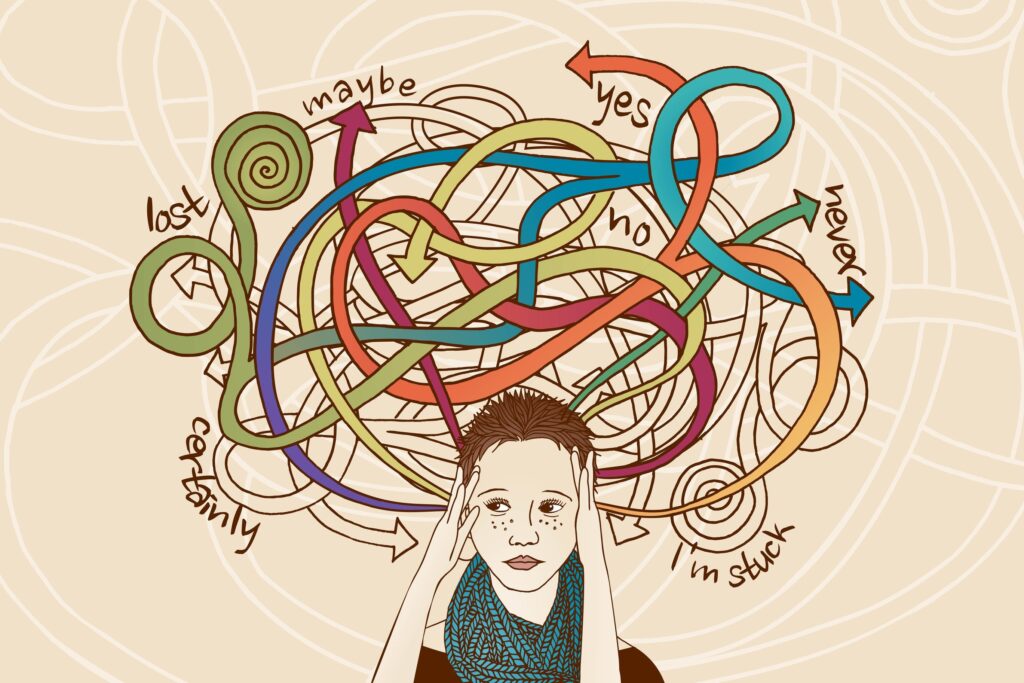
And then I began facing a challenge that psychologists eloquently describe as Catastrophisation – a word that most spell-checks still do not recognise. But, that doesn’t mean it doesn’t exist. For a long time since my personal bereavement almost a decade ago, I became aware of a gnawing fear of future loss. A nasty bike accident made it stronger as did a few other stray incidents. It was almost as if I was creating a worst-case scenario for the future and willing it to happen.

What’s more, it was as though some voice within my head was convincing me that I had the power of divining my future, and maybe those of others who happened to be part of my ecosystem. Each time a piece of information came to my notice, a similar occurrence or instance from the past would bubble up and I would involuntarily join the dots to create the same outcome like last time. If that is difficult for my readers to comprehend, I don’t blame them. It is a mental health issue.

The ludicruousness of this exercise would pop out at me at most times, save for those where the force of historical context would push me towards a wannabe catastrophe. It happened in the past, and all of the data available now points to a repeat. Where was this coming from? An incident from this very day gave me some clarity and lots of hope that things aren’t as bad as I thought they would be.

During a conversation, I recalled instances from several years ago, which I promptly shared with my interlocutor. The only response I got for my efforts at unearthing a piece of information was “maybe, I guess so.” I was incredulous. ll those years back, it was my present interlocutor who had furnished me with that bit of information. Now the person claimed no memory of the same. WTF??? The person has no memory of it and here I was narrating it out. During this exchange, I also sensed a feeling of discomfort over the “frivolity” of my interlocutor. I mean how could they forget something they told me?

And then it snapped into place. The piece of information was irrelevant to both of us today. It may have had some relevance all those years ago, but didn’t serve any purpose now. And the person who had no recollection of it was in a happier place, not the one who carried it around in the depths of their memory. And in doing so, I suddenly became aware of how this very capability consistently helped me connect the dots around complex economic, political and geographic facts and events as part of my profession.

This was a habit I cultivated as a professional journalist back in the time when there was no Google, no internet and heck… no computers. Remembering data from a previous article helped me immensely while crafting a new one. Those days my pals used to describe it as the “Cow and the Coconut Tree” technique. This story revolved around a kid who uses her smarts to write about the latter when the examiner wants an essay crafted on the former.

It was indeed a blessing to have those days. However, today the very same habit has become a curse. One where the very same faculties that assisted me are causing me to connect the dots into an imaginary universe and then waiting around fearfully for their fruition. Events, incidents, words – things just come back swirling out of the mental mist when I least need them. Yes, you read that right. When I least need them. They make no sense and have no logic and not even an iota of emotion. They just spring up and convert a perfectly happy moment into one of mild panic.

So, how does one turn the curse into a blessing once again, I wondered. There is no easy way to do this, because when I try to break this pattern, it stops for a while. For that particular instance. Only to resurface with a new memory that’s long been buried. It wriggles out and fits perfectly into whatever it may be that I am processing at a particular moment. The stream flows on until something happens to distract me from that particular thought. The pattern repeats without my discretion.

So, what should I do? I asked a friend and mentor. The answer was simple. Stop running away from it. Just stay with it. Let it play out. Watch the thinker.

Share this Post[?]